
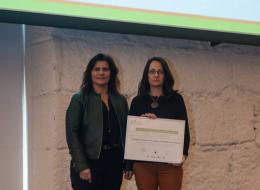
BIOTESTE Project received an Honorable Mention in the 10th edition of the Green Project Awards
The project BIOTESTE - rapid diagnostic tests based on biopolymer produced by bacteria from food waste received an Honorable Mention in the 10th edition of the Green Project Awards, whose award ceremony took place on 2018 January 12 at the Centro de Congressos da Alfândega do Porto.
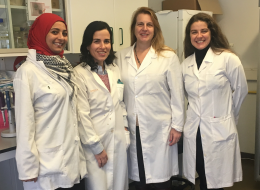
Ana Freitas’s publication highlighted as an Editor’s Choice in Journal of Antimicrobial Chemotherapy
An important finding has been published in Journal of Antimicrobial Chemotherapy by Ana R. Freitas, Houyem Elghaieb et al., from the Bact-Drugs Lab at UCIBIO in Faculdade de Farmácia-Universidade do Porto (FFUP), led by Luísa Peixe, Professor at FFUP.
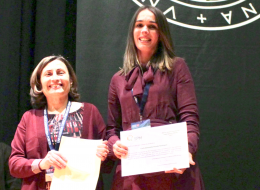
Carla Rodrigues awarded “Prémio Jovem Investigador - Isabel Spencer Martins”
Carla Rodrigues, a Post-Doctoral researcher from Bac_Drugs Lab group from UCIBIO at Faculdade de Farmácia da Universidade do Porto, was awarded the “Prémio Jovem Investigador - Isabel Spencer Martins” by Sociedade Portuguesa de Microbiologia (SPM).
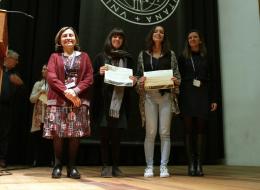
Sara Pais awarded “ALFAGENE - Jovem Investigador em Microbiologia”
Sara Pais, PhD student in the Infection Biology Lab (led by Jaime Mota), at UCIBIO - FCT NOVA, was awarded the “AWARD ALFAGENE - Jovem Investigador em Microbiologia” for the best communication presented at the Congress of Microbiology and Biotechnology (MICRIOBIOTEC’17), held in Porto, Portugal (7-9 December 2017).